
NIS2, DORA, and Apache Kafka
If your company operates in Europe, the regulatory landscape for IT infrastructure just shifted beneath your feet. Two major frameworks—NIS2 and DORA—are raising the bar for digital resilience.
For teams running Apache Kafka, this poses a specific, often overlooked challenge. Engineers often assume that Kafka's replication makes them "safe." Under the strict definitions of these new laws, replication alone leaves you non-compliant.
Here is what you need to know about the regulations, why your current Kafka setup might be at risk, and how Kannika Armory bridges the gap.
The New Sheriffs in Town: NIS2 and DORA
Let's cut through the acronyms. These regulations target different sectors but share a common goal: your business needs to survive and recover from a digital disaster.
NIS2 (Network and Information Security Directive)
- Who it affects: Essential and important entities across critical sectors (Energy, Transport, Health, Digital Infrastructure, and more).
- The Mandate: It shifts the focus from "preventing breaches" to business continuity. You're legally required to restore data and operations quickly after an incident like ransomware or human error.
DORA (Digital Operational Resilience Act)
- Who it affects: Financial entities (Banks, Insurance, Investment Firms) and their critical ICT providers.
- The Mandate: DORA is incredibly strict about resilience. You need to demonstrate—through rigorous testing—that you can recover your systems to a clean state after a disruption.
The Bottom Line: Both regulations require proven recoverability. If your Kafka cluster crashes or gets corrupted today, can you guarantee a clean restore to yesterday's state at a specific point in time?
The "Replication Trap": Why Kafka is Not Compliant Out-of-the-Box
This is where many engineering teams get into trouble. It is common wisdom to say, "We don't need backups; we have a Replication Factor of 3. If a broker dies, we are fine."
For Availability (keeping the lights on), this is true.
For Compliance (data recovery and integrity), this is false.
Here is why replication fails the NIS2/DORA test:
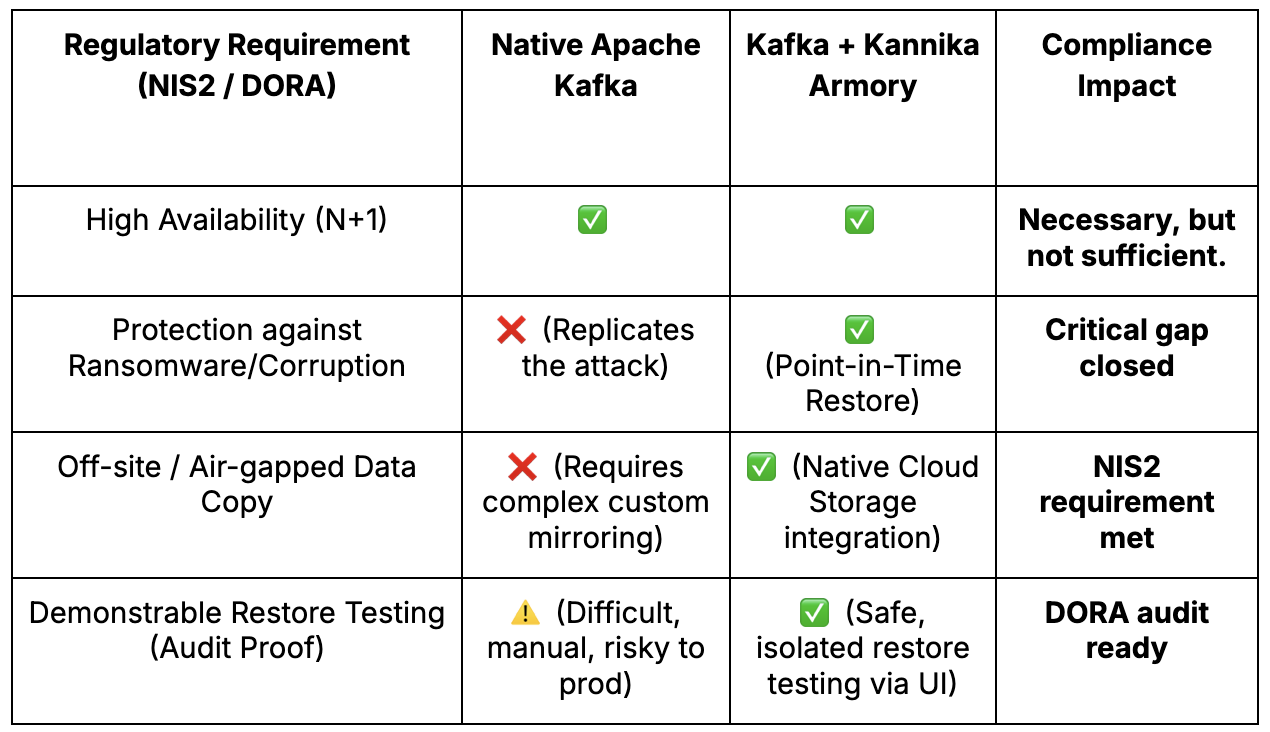
- Replication propagates corruption instantly: If a buggy microservice writes bad data to a topic, or an admin accidentally deletes a critical topic, that error replicates to all copies in milliseconds. You now have three copies of corrupted data. DORA requires you to restore a clean version.
- No Point-in-Time Recovery (PITR): If ransomware hits at 10:00 AM, you need to restore your data to 09:59 AM. Kafka replication can't do this, it only gives you the current state.
- Cluster-level failures: If your entire Kubernetes cluster or data center goes dark (a scenario NIS2 explicitly asks you to plan for), your replicated brokers go down with it.
To be compliant, you need an off-site, immutable snapshot of your data that lets you rewind time.
How Kannika Armory Solves the Compliance Gap
We built Kannika Armory to handle the scenarios that native Kafka tools miss. Here's how Armory maps directly to NIS2 and DORA requirements.
1. True "Air-Gapped" Resilience (NIS2 Requirement)
NIS2 requires you to mitigate the risk of physical or catastrophic system failure.
- The Armory Solution: Kannika Armory offloads your Kafka data to external, durable storage like AWS S3, Azure Blob Storage, or Google Cloud Storage. Even if your entire Kafka cluster is deleted, your data sits safely in a separate vault, ready to be restored into a new environment.
2. Point-in-Time Recovery (DORA Requirement)
DORA mandates that you must be able to recover from data integrity issues.
- The Armory Solution: Armory allows point-in-time recovery. If a deployment corrupted your customer orders topic at 14:30, you can restore that specific topic to its state at 14:29, filtering out the corruption while keeping the rest of your business running.
3. Auditability and Testing (Both)
Both regulations require you to prove you are safe. "We think it works" is no longer an acceptable answer to an auditor.
- The Armory Solution: With our management UI, you can easily perform and visualize restore tests. Spin up a test environment, restore a backup, and prove to auditors that your Recovery Time Objective (RTO) is within limits—without impacting production traffic.
Compliance Readiness Matrix: Native Kafka vs. Kannika Armory
Next Steps for DORA & NIS2 Readiness
Compliance isn't just a checkbox; it is about ensuring your business survives the worst-case scenario. If you are running Kafka in production, here is a simple 3-step assessment to gauge your readiness today:
- Define your RPO and RTO: Ask your business stakeholders: "If we lost our Kafka cluster right now, how much data can we afford to lose (RPO), and how fast do we need to be back online (RTO)?"
- The replication test: Look at your current Disaster Recovery plan. If the word "replication" appears as your primary defense against data corruption or ransomware, you have a compliance gap.
- Audit your air gap: Do you have a copy of your data that is completely isolated from your Kubernetes cluster and administrative credentials? If not, you fail the NIS2 resilience requirement.
Bridge the Gap with Kannika Armory
You don’t need to re-architect your entire data mesh to become compliant. Kannika Armory plugs directly into your existing infrastructure to provide the safety net that NIS2 and DORA demand.
Ready to secure your data and meet compliance requirements?


Kafka Connect Isn’t a Backup Strategy
Think Kafka Connect is your safety net? It might be the reason recovery fails.

The difference between redundancy and backup
Kafka replication protects you from server failure, not data loss. Learn the critical difference.

Performance was the main reason
KOR limits period of downtime with Kannika Armory as fast back-up and restore solution for Kafka
