Building a decentralized event fortress with Akave
Think your event data is completely safe just because your Kafka cluster has high availability? Think again.
Event-Driven Architectures are changing. We no longer treat Apache Kafka as a simple, transient queue. Today, it acts as a persistent source of truth for critical business operations. This shift brings new challenges to the surface.
Why you shouldn’t rely on hyperscalers
When you rely completely on centralized cloud storage, you introduce vulnerabilities to your data. The first major issue is the assumption that high availability is the same as a backup. Standard replication protects your systems against hardware failure, but it offers zero protection against human error or data corruption. If one of your developers accidentally deletes a critical topic, the system replicates that deletion instantly across all nodes.
Beyond human error, centralized storage buckets act as massive single points of failure. A single set of stolen credentials can lead to total data deletion. On top of these security risks, traditional hyperscalers penalize you for managing your own data. Storage costs scale poorly with the high volume of event streaming, and providers charge unpredictable egress fees when you move or restore your backups.
An air-gapped history of your events
To provide you with a safe and cost-effective alternative, we directly integrated Kannika Armory and Akave Cloud.
Akave provides an S3-compatible decentralized storage layer that works natively with our tools. Together, they give your infrastructure an air-gapped and immutable history of your business events. Your backups are cryptographically secured with Merkle trees and Content Identifiers, and they stay completely verifiable on the ledger if ransomware strikes your primary cluster.
This integration also helps you control your cloud bills. Kannika compresses your data down to 10% of its original volume. Meanwhile, Akave charges up to 80% less than traditional hyperscalers. That means you can reduce your total cost of ownership by up to 90%. You also never pay egress fees when you restore your own data. Finally, Akave provides geofencing capabilities so you maintain GDPR and HIPAA compliance. Kannika Armory connects right to the interface, with absolutely no code changes required.
How does it work?
It’s pretty simple, actually. The data flows directly from Kafka to Kannika and then straight to Akave:
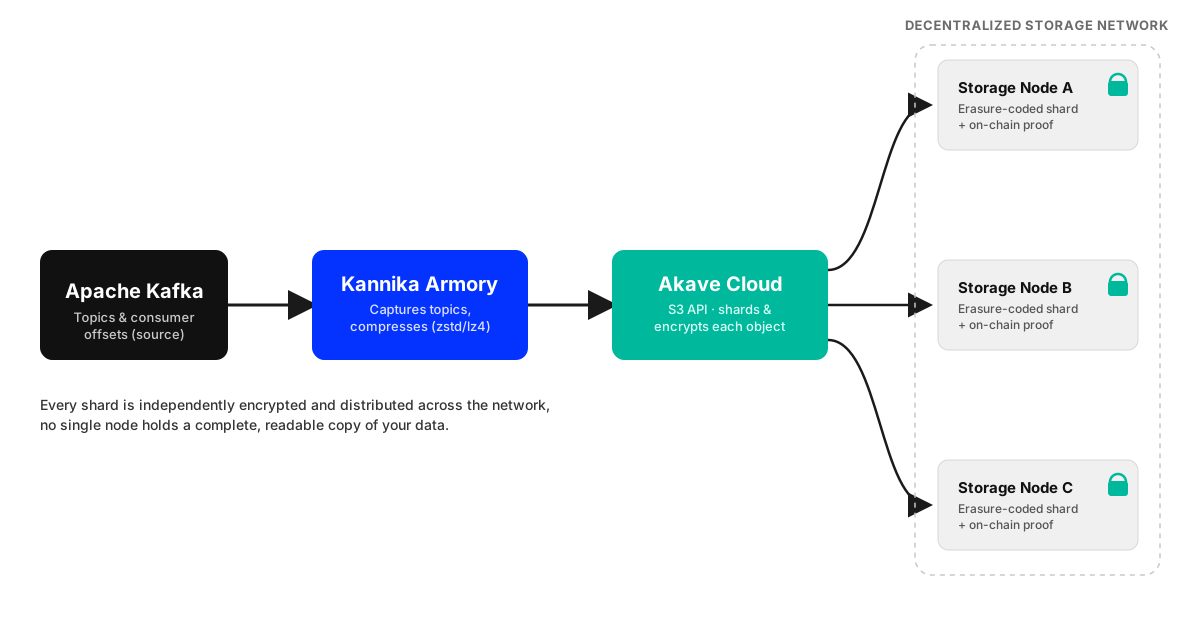
- Kannika Armory connects to an event hub and captures topics and consumer offsets in real-time.
- Using Zstandard or lz4 compression, Kannika shrinks the data to a fraction of its original size.
- The backup is sent to Akave via the S3-compliant API.
- Akave shards, encrypts, and distributes the data across independent storage nodes in its decentralized network.
- Every storage action gets logged on the Akave blockchain ledger for a transparent audit trail.
How can you use it?
With the combination of Kannika and Akave, you can cover several critical use cases.
- Hit by a ransomware attack? You can pull clean data from immutable storage and restore your cluster to a precise millisecond before the attack.
- You can store petabytes of historical event data for financial regulations without paying the usual high-performance cloud storage prices of hyperscalers.
- You can back up distributed Kafka clusters at the edge and maintain data integrity across thousands of locations. Again, without having to break the bank!
Not sure if Akave is the right fit for your setup? Get in touch with us and we’ll gladly help you out.

NIS2 and DORA compliance for Kafka environments
NIS2 and DORA require provable Kafka backup and recovery; replication alone does not meet compliance requirements

How Kannika saves you money on Kafka
Kannika lowers Kafka costs by replacing DR clusters, offloading long term storage, and reducing developer overhead

Protecting Kafka from ransomware and cyberattacks
Ransomware can encrypt Kafka data across replicas; only isolated backups enable reliable recovery after an attack
